Tuesday, July 30, 2013

Life After Life: The Rector Reflects

Today we are joined by guest blogger Rev. Gary Jones, Rector of St. Stephen's.

I loved this book, and I am grateful to our vicar, Weezie Blanchard, for suggesting it as our parish summer reading book. Jill McCorkle has given us a gift by taking us inside the hearts and minds of people in a retirement community in North Carolina. I loved the musings of the individual residents, as they pondered their lives and what mattered most to them. But I also always looked forward to reading Joanna’s notebook entries (sensitive reflections by a hospice volunteer who knew she was on sacred ground in appraising people’s lives). And the short, stream-of-consciousness musings of the dying themselves in the very last moments of their lives … these are sheer poetry. I was sorry when the book ended; I felt as if I were leaving good friends.

 photo lifeafterlifewords_zpsba486b4d.jpg

The range of characters and their life experiences is pretty amazing. From the little girl, Abby, who feels more at home in the Pine Haven retirement community than in her own dysfunctional home, to Kendra (Abby’s social-climbing, materialistic, and neurotic mother), to Rachel (the sharp, driven, professional woman from Boston), to Toby and Sadie and Stanley and C.J. … it’s hard not to love all of these people, and to feel for them in their private reflections. There’s a despicable villain or two, but even they help us reflect on the corrupting influences of wealth, power, and even religion.

One of the things I have cherished most about my role as a parish priest is the opportunity I’ve had to share in people’s innermost lives. Secret longings, deepest loves, anxious fears, hounding regrets…. By and large, people are not hesitant to share their victories and achievements with just about anyone. But that is just the tip of the iceberg of a human life, the little part that sticks out above the water line that anyone can see. There’s so much more to who we are that is submerged and hidden.

 photo 66049a84-d815-4efe-8c6c-4f3ee0ea963c_zps5a1ae1bb.jpg
Monk By the Sea by Leo de Fryne

Some of that hidden part we need to share with someone, and sometimes people choose to share it with a priest. After hearing people talk about some of their hidden lives, I’ve often reflected, either silently or aloud, that if we only knew more of the truth about each other, the world would be a much more compassionate place. All too often, we go around comparing our insides (the secret, interior truth about how we are really getting along in the world) with other people’s outsides (the apparent truth about how other people are doing).

The result, of course, is that we end up believing that other people are doing so much better than we are. Other people seem, on the outside, to be so much better put together, while we know, inside, that we are a mess – other people’s marriages are happier, their home lives are so much more fulfilling, their professional lives are more successful, and psychologically, everyone else seems so much more grounded and balanced.

I’ve often thought that, if only we knew the truth about each other, we’d probably all feel more normal and could relax a little more. We would also surely be more sympathetic, tender, and kind toward each other. It seems to me that Jill McCorkle’s way of taking us inside the hearts and minds of her characters and their life stories has just this effect. We feel deeply for Stanley when his tough-guy charade falls apart; Rachel’s disillusionment about her lover is heartbreaking; Sadie’s optimism and appreciation for the simple things of life are inspiring; C.J., though deeply wounded, nevertheless is spiritually resilient; and Abby’s childhood lens helps us to see ourselves in a new way, which is by turns hilarious and heartbreaking.

But much of the vast, submerged part of our lives remains hidden, not only from people we love most, our spouses and children, and from trusted confidantes like parish priests, but even from ourselves. And Jill McCorkle even manages to plumb the depths of these mysterious parts of her characters, at least indirectly, by giving us several different perspectives on each person – the characters’ own reflections on their lives, the reactions of the characters to one another, Joanna’s notebook entries from the last days and hours of a person’s life, and then the final, poetic stream-of-consciousness musings from the person at the time of death. It all amounts to complex, soulful, and tender portraits of people like ourselves, and people with whom we interact every day.

 photo 74573963-a189-4bd3-bfba-1ae629896384_zps3c1ec0c7.jpg\
The Windows of Heaven Are Open by Sook Jin Jo

In a way, the drama at the end of the novel distracted me from a deeper consideration of the richness of the various portraits throughout the book. But the ending does highlight how desperate longing, on the one hand, and excessive pride and inflated ego on the other, can lead to terrible tragedy and disgrace.

One of the effects of this novel for me anyway is that it helps me to remember that the complexity I sense inside myself – the beauty and wonder, as well as the corrupting ego and miserable failure – these and other complexities, born of very different experiences, are just as poignant inside all of the seemingly well-put-together people who are all around me every day. In the words of the Psalm, “we are fearfully and wonderfully made.” How important it is to avoid being judgmental; and how important it is to be patient and gentle with each other.

Friday, July 19, 2013

Life After Life: New Beginnings


Today we are joined by guest blogger Jack Deloyht, a parishioner at St. Stephen's
Everyone in Life After Life, with a couple of egregious exceptions, is someone I’d like to meet. They are sympathetic characters, of both wonderful and very human spirit. It would be interesting to know if it is really like this in a senior living facility. (I am not there yet but I suspect I ought to be.) I wonder if dying is like any of the instances described between the main segments of the story. I will be there in time and I suspect I’ll find out.
It is interesting to follow the back stories of each person profiled in the story, no matter how brief the segment given to a characterization. I feel as if pieces of these histories belong to my life.
Everyone in this novel moves to a new beginning, including those who die. There are also one or maybe two instances where the new beginning portends an unsalutary outcome. Each character travels there with personal conflicts, even when they are barely aware of them. This has helped my understanding of a recasting of the Lord’s Prayer presented by John Philip Newell in a wonderful little book entitled Ground of All Being, which has beautiful photographs of a Celtic Christian retreat center in New Mexico accompanying each line.
 
Newell recasts “Lead us not into temptation, but deliver us from evil,” replacing it with “Do not forsake us in our time of conflict, but lead us into new beginnings.” Reading Life After Life has given me insight as to why this recast may be a valuable and appropriate alternative version of the prayer.

 
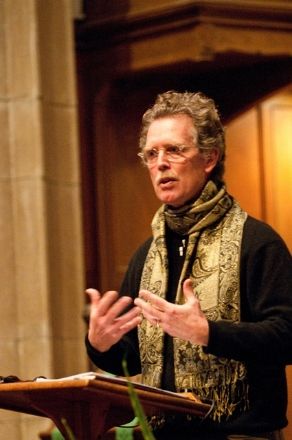
Editor’s note: John Philip Newell, pictured above, is a frequent speaker here at St. Stephen's.The complete text of Newell’s contemporary version of The Lord’s Prayer may be found below.
Ground of all being,
Mother of life, Father of the universe,
Your name is sacred, beyond speaking.

May we know your presence,
may your longings be our longings in heart and in action.
May there be food for the human family today
and for the whole earth community.

Forgive us the falseness of what we have done
as we forgive those who are untrue to us.

Do not forsake us in our time of conflict
but lead us into new beginnings.

For the light of life, the vitality of life, and the glory of life are yours now and for ever.
Amen.

Friday, July 12, 2013

For Everything There is a Season

For everything there is a season, and a time for every matter under heaven:

a time to be born, and a time to die;

a time to plant, and a time to pluck up what is planted;

a time to kill, and a time to heal;

a time to break down, and a time to build up;

a time to weep, and a time to laugh;

a time to mourn, and a time to dance;

a time to throw away stones, and a time to gather stones together;

a time to embrace, and a time to refrain from embracing;

a time to seek, and a time to lose;

a time to keep, and a time to throw away;

a time to tear, and a time to sew;

a time to keep silence, and a time to speak;

a time to love, and a time to hate;

a time for war, and a time for peace. Ecclesiastes 3: 1-8, NRSV

 photo bb9d2c1e-07ad-44c5-9010-a34d46cceb26_zpsb6d9ec99.jpg Gathering Stones by Robert McGregor, 1877

In many ways, Life After Life is a book about reviewing a life, taking stock of what was, and laying claim to it-- good and bad. We all hope to be able to recognize the particular seasons of our lives, and to be able to respond accordingly. There is an echo of this desire in the Lord's Prayer, when we pray to be given our daily bread.

How do the characters in the book fight against their season of life? How do they embrace their circumstances?

How do you?

Friday, July 5, 2013

Life After Life: A Cinematic View

Today we are joined by guest blogger Rev. Weezie Blanchard, Vicar of St. Stephen's.

I recently saw the movie Quartet, which takes place in a home for retired musicians. Like the characters in Life after Life, the characters in Quartet are all in some ways in reduced circumstances. Most of them had been well-known, and some had even been famous, but now they live in their own rooms and share much of their lives. Like the characters in Life after Life, many of the characters in Quartet are in various stages of mental and physical decline; some are flamboyantly in their dotage and others struggle to hide what they've become. But even as their bodies and minds fail them, they find joy and sort out sorrow. They make peace with their pasts and resolve old differences.

 photo quartet_zps4f6ecd4c.jpg

A big difference between Quartet and Life after Life is that the book takes us into the characters’ minds and hearts. We learn what they're thinking, and we learn something about what made them the people they've become. We see beyond what others can only observe. In fact, we learn what most of the characters spend most of their lives trying to hide. For me, that's when I feel that I’ve really come to know them. I’m touched by the vulnerability that’s at the heart of all of us, no matter what our facades indicate. But that’s too much information for some of us, and it makes us uncomfortable.

Do you feel like you know more than you want to know about the characters in Life after Life?

On a lighter note, seeing Quartet made me think about who might play the characters in Life after Life the movie.

Friday, June 28, 2013

A Room of One's Own

In her 1929 essay of the same title, Virginia Woolf famously described the importance of having "a room of one's own." She was describing the personal, financial, and poetic autonomy necessary for a women to write fiction, but really the same holds true for any repeating, life-long endeavor-- including the life of faith, the raising of a family, or dedication to any long-term creative project.

In Life After Life, the residents' rooms represent the entirety of their personal space: the winnowing down of a lifetime and various households into whatever will fit by a hospital bed. A Sunday school class visits Pine Haven and suggests the residents name their rooms "like you might a home at the sea or a bedroom in a bed and breakfast" (p. 125), and the residents follow suit, choosing names from "Camelot" (Marge) to "The Cell of Hell" (Stanley, of course.)

 photo 4fed2e82-cfff-4664-99e6-0e3befdca8c2_zps1b28488b.jpg
Small Drawing Room by Marc Chagall, 1908

Honestly, though, this section is a little sad. These people are decidedly not in a home at the sea or a B&B, as Rachel's wry choice of "My Apartment" points up. However, the larger question of having a little patch of somewhere to call one's own-- no matter one's age or how limited one's circumstances-- is certainly valuable.

Do you have a "room of your own?" Is it somewhere you will visit this summer? Is it a place you hope to have throughout your life, or is it something more temporary?

Friday, June 21, 2013

Surprise Lessons

The best lessons in life are the surprising ones-- the ones that sweep us off of our feet and leave us disoriented, bewildered, and wondering exactly what just hit us.

These aren't comfortable moments. Those are instructive, too, and perhaps more welcome, but it's rarely the easy lessons that unstick the gears and usher in real change.

Stanley is a character made up of surprising lessons. He's not nearly as affable as some of the other residents of Pine Haven, espeically as we experience him from their eyes. He is rude, loud, and stunningly inappropriate, turning the most innocent remark into a target for lewd innuendo. But then, right in the middle of the novel (beginning with p. 155), we're finally treated to his point of view. It is nothing if not honest.

Stanley knows he is not a good father. Stanley knows he was not a good husband. And at first, as he discusses his life, he truly does not seem to care, so why should we? Cranky and curmudgeonly and such a slave to his own stubbornness, he pushes people away even as he longs to draw them near.

Alexej von Jawlensky Bauer Summer Reading 2013 photo edb42f34-e676-4df9-92eb-ae55af8c528a_zps995adeaf.jpg
Bauer by Alexej von Jawlensky, circa 1912

Then we learn his secret. Stanley's wife Martha has died, and as he lies in bed one night positively steeping in bitterness and regret-- much of which involves his failed relationship with Ned, his youngest son-- Ned slips into his room and lies down to keep his father company.

Stanley hates it. He hates it because he actually loves it, as he loves Ned. He uses his son's closeness as an excuse to beat himself up, wrestling with his demons until he creates a fiction for his life that will, in some ways, absolve him.

He acts as is his own confessor in creating this act of penance: faking dementia and putting himself out of the way in a retirement home.

From p. 165:

"After a week of Ned lying there at night and their quiet breakfasts together that had become something Stanley looked forward to, he began thinking up his plan. He would slowly start to slip. He would ease himself into a character, an actor on the stage. He would be obsessed with wrestling and just rude enough to keep people at a distance. He would not shave every morning...He would convince his sons he couldn't remember things...he would make them believe with great conviction that he needed to live in one of those retirement places and and then everyone would be on his own, and if Ned had any chance of making it in life, he'd have the freedom to do so."

What do you think of Stanley? Is it possible that he has redeemed himself with this screwball plan? Is this an act of love, or the final nail in the coffin of any possibility for honest relationship with Ned?

Friday, June 14, 2013

Rope Passers

Much of Life After Life is told from the point of view of Joanna, a volunteer hospice nurse to the residents of Pine Haven Estates. She has been married several times, keeps her father's old hot dog joint up and running, and was saved from an attempted suicide when a dog named Tammy kept her from drowning.

 photo siredwinhenrylandseer_zpsf08e6fe3.jpg
The Distinguished Member of the Humane Society by Sir Edwin Henry Landseer, 1831

As Joanna tells it:

"After it was all over, she thanked him for saving her and he said that really Tammy saved her. All he did was let the giant dog out to pee. He said there were two kinds of creatures in the world-- there are those in dresses fighting for the lifeboats and there are those making sure that others are okay, like the man in the footage of that plane crash in the Potomac who passed the life rope so many times he didn't make it himself. 'No doubt,' Luke said, 'I love the feel of a skirt, especially something in crepe or silk, but the honest truth is that I really want to be a rope passer. I like to believe that's what I'd do.' He pulled Tammy in close and kissed her big head. "Tammy is a rope passer. Tammy is a big voluptuous angel from heaven.'" pp. 69-70

What does the phrase "rope passer" evoke for you? Have you ever known someone like this?

Have you ever known a remarkable animal like Tammy?